Solar Installation Regulations in NZ: Do You Need Consent?
Solar installation rules in New Zealand are the three separate compliance checks a home solar system has to clear: a building consent exemption check, installer accreditation with the Electrical Workers Registration Board (EWRB), and grid-connection approval from your local electricity distributor. Most standard residential rooftop installs need no building consent at all, because they fall under the low-risk building work exemptions in the Building Act 2004 — but "exempt from consent" is not the same as "exempt from rules." A compliant install still has to meet the Building Code, be carried out by an EWRB-accredited electrician, and get sign-off from your local lines company (the regional company that owns and operates the electricity network your home connects to) before it's switched on. Skip any of those three checks and you risk a warranty or insurance problem down the line, not just a compliance technicality. This guide covers residential and small-to-medium-scale systems — large-scale or utility-scale solar farms sit under a separate regulatory track and aren't covered here.
Quick answer: a typical suburban roof-mount install under 40m² needs no building consent, does need an EWRB-accredited installer working to named electrical standards, and does need grid-connection approval from your local network — see our solar installation process guide for how those steps fit into the overall install timeline. Note also that a government-commissioned review of these exact rules reported back in July 2026, and on 10 August 2026 Cabinet agreed a package of decisions to progress its recommendations — covered below, since some of what you read elsewhere may already be out of date.
| You are | What applies |
|---|---|
| Homeowner, standard roof-mount install | No building consent (if under 40m², standard wind zone); EWRB-accredited installer required; lines company approval required |
| Homeowner, larger/complex array or high wind zone | Still no consent application, but design must be done or reviewed by a Chartered Professional Engineer |
| Renter or apartment-dweller | Rooftop rules don't apply to you directly; plug-in/balcony solar is not yet legal, but Cabinet has agreed to progress regulatory changes to enable it — see below |
Do you need building consent for solar panels in NZ?
Under Schedule 1 of the Building Act 2004 — the schedule listing building work exempt from needing a formal consent application — most standard residential rooftop solar installations count as exempt low-risk building work, meaning you don't need to apply for a building consent before installing. That exemption is why solar has become a straightforward add-on for most NZ homes rather than a resource-heavy consent process.
The exemption has two specific thresholds (in force since 23 October 2025, per Building Performance's building consent exemption changes):
- Under 40m², standard wind zone: a roof-mounted solar panel array less than 40 square metres in area, installed in a wind zone no greater than "high," needs no building consent at all.
- 40m² or more, or a higher wind zone: an array at or above 40 square metres, or sited in a wind zone greater than "high," is still exempt from a formal consent application — but its design must be carried out or reviewed by a Chartered Professional Engineer before install.
Most single-dwelling rooftop systems (a typical home array is well under 40m²) fall into the first category and clear this check without any paperwork. It's worth confirming with your installer or council rather than assuming, though, in cases like these:
- Ground-mount systems above a certain size, or on sloping/unstable ground (covered by a separate, related exemption).
- Heritage-listed buildings or properties in a heritage overlay, where any exterior change can trigger a different consent pathway.
- Unusual roof structures — an older roof, a non-standard pitch, or a roof an engineer flags as needing a structural check before panels are added.
- Battery systems that add significant weight or change the building's electrical layout beyond a standard install.
One important distinction: being exempt from applying for a consent does not exempt the work from the Building Code itself. Your installer is still responsible for meeting structural and weathertightness standards — the exemption just means no separate consent application is filed for a standard job.
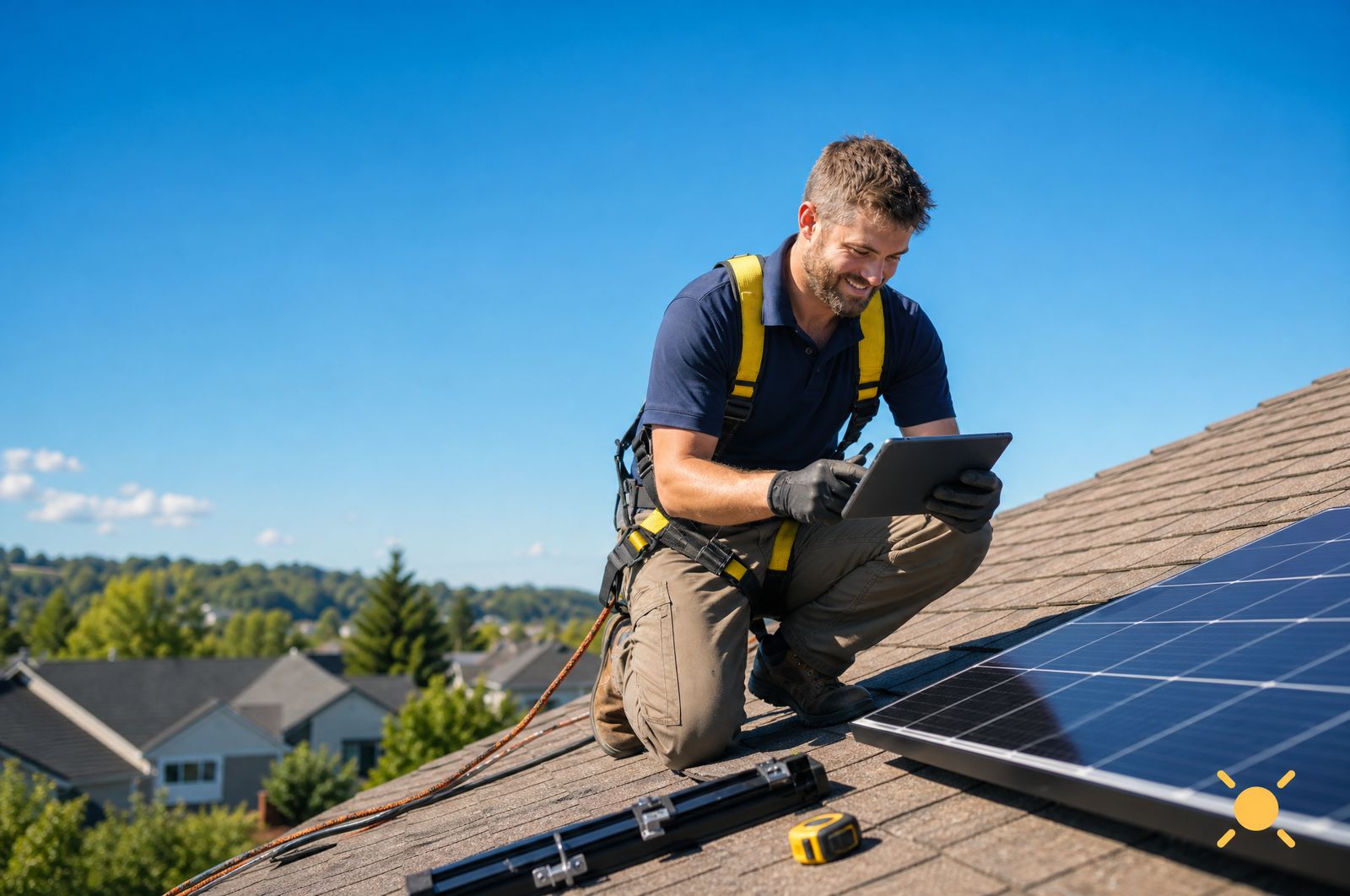
Installer accreditation, EWRB rules & the standards they work to
From September 2026, electricians installing grid-connected solar and battery systems in NZ must hold a specific Electrical Workers Registration Board (EWRB) accreditation for that work — general electrical registration on its own is no longer enough for this category of install. Checking that your installer holds this accreditation, not just a standard electrician's licence, is the single easiest compliance check a homeowner can do before signing a quote.
- Ask for the accreditation directly — a legitimate installer will have no trouble producing it; treat hesitation as a red flag.
- SEANZ membership — membership of the Solar Energy Association of New Zealand is a further signal of an installer committed to industry standards, though it's not a substitute for EWRB accreditation itself.
- Insurance — confirm the installer carries current public liability and workmanship insurance, separate from the panel manufacturer's product warranty.
Beyond the accreditation itself, a compliant install has to meet a specific set of joint Australian/NZ electrical standards. You don't need to memorise these, but it's a fair question to put to any installer:
| Standard | Covers |
|---|---|
| AS/NZS 5033 | Installation and safety requirements for the solar (PV) panel array itself |
| AS 4777.1 | Grid-connected inverter — the component that converts panel output to grid-usable power |
| AS/NZS 5139 | Battery storage systems (best practice), where a battery is part of the install |
| AS/NZS 4509 | Stand-alone (off-grid) systems, rather than grid-connected ones |
| AS 4086 & NZS 4219 | Battery installations specifically — secondary battery safety and the seismic performance of engineering systems in buildings |
A newer consolidated reference, SNZ PAS 6014:2025 (Residential solar photovoltaics and battery storage systems guidelines), pulls the individual battery and PV standards together into a single best-practice document — worth asking your installer about if a battery is part of the job.
These checks matter beyond the paperwork: they're also what most manufacturer warranties and home insurance policies quietly assume was done. See our solar panel maintenance guide for how accredited work also affects who can legally service the system later.

Grid-connection approval with your lines company
Grid-connection approval is sign-off from your local electricity distributor — your "lines company" — confirming the local network can safely accept power flowing back from your solar system. Any solar system that connects to the grid — which is most residential installs, as opposed to fully off-grid systems — needs this approval before it can be switched on. This is separate from building consent and from EWRB accreditation; it's specifically about network capacity, not building compliance or installer credentials.
In practice, a good installer manages this application on your behalf as part of the install process, covering:
- Export limits — how much power your system is allowed to send back to the network, which can be capped in some areas depending on local network capacity.
- Metering changes — most homes need a meter upgrade or reconfiguration to measure power flowing both ways.
- Network capacity checks — the lines company confirms the local network can handle your system's size before granting approval.
- Independent inspection sign-off — an independent electrical inspector checks and signs off the completed system before it's activated on the grid, on top of the installer's own compliance responsibility.
If your system exports power back to the grid, the installer's application follows Part 6 of the Electricity Industry Participation Code 2010 — the specific rulebook the Electricity Authority administers for connecting small-scale generation like rooftop solar to a local network. Timelines vary by lines company and region, so ask your installer upfront how this step fits into your project's overall schedule alongside the steps covered in our installation process guide.
Council and district plan considerations
Building consent exemptions sit under national rules, but your local council's district plan can still apply separately in a handful of situations — most commonly heritage overlays, height-in-relation-to-boundary rules for ground-mount arrays, or specific zone rules in some rural or coastal areas. These are the exception rather than the norm for a standard rooftop install, but they're worth a quick check with your council if your property falls into one of those categories, or if your installer flags it during the site assessment.
Rules that may be about to change
The rules above are current today, but a package of changes is now being progressed. The Ministry for Regulation completed a formal review of New Zealand's residential and small-to-medium-scale solar regulatory settings, reporting back in July 2026. The review found the current process for installing solar can be more complex and slower than it should be — homeowners can face multiple steps, unclear requirements, and delays spread across building rules, planning processes, electricity network approvals, metering, and inspections.
On 10 August 2026, Cabinet considered the review and agreed a package of decisions to progress its recommendations. The agreed next steps include:
- Amending Schedule 1 of the Building Act 2004 to clarify the building consent exemption settings covered above.
- Progressing more nationally consistent planning rules, to cut down how often a resource consent is needed.
- Exploring a time-limited trial of a more proportionate, risk-based approach to electrical inspections.
- Progressing regulatory amendments to enable plug-in solar in New Zealand — small plug-in panel systems, sometimes called balcony solar, that are not currently legal to connect. This is framed as a lower-cost option particularly useful for renters and others who can't install a traditional rooftop system.
- Referring the review's recommendations on electricity network approvals, metering, and retailer processes to the Electricity Authority for its own consideration.
The Ministry estimates the package could deliver a net benefit of $28–50 million over 10 years, mainly through fewer delays and lower compliance costs. Cabinet's agreement is a decision to progress the work, not a change in the law yet — the Building Act amendment, the planning changes, and the plug-in solar enablement each still have their own implementation process to go through, with responsibilities split across several ministers, agencies, and regulators. Until each piece actually takes effect, every rule elsewhere on this page is what applies. We'll update this guide as each recommendation moves from agreed-in-principle to law.
What happens if you skip the rules
Skipping any of these requirements is rarely about avoiding a fine — it's about what happens later, when it matters most:
- Voided warranty — most manufacturer product and performance warranties are conditional on installation by an accredited installer; a non-compliant install can void that cover entirely.
- Insurance gaps — home insurers can decline a claim connected to an installation that wasn't carried out or connected to code, even years later.
- Resale friction — an undocumented or non-compliant install can surface as a discrepancy against your council file or LIM report when you come to sell, creating delays or price-chip conversations at the worst possible time.
- Safety — grid-connection and electrical work exist as rules for a reason; non-accredited electrical work on a grid-tied system is a genuine safety risk, not just a paperwork gap.
None of this is a reason to be wary of solar — it's a reason to choose an installer who handles consent-exemption checks, EWRB accreditation, and lines company approval as a standard part of the job, the same way our 6kW solar system cost guide assumes a fully compliant install as the baseline for its pricing. Before you sign a quote, a three-step self-check covers the ground above: 1) ask for EWRB accreditation (not just a general electrician's licence); 2) confirm which consent-exemption class your array falls into, and whether a Chartered Professional Engineer needs to sign off the design; 3) confirm your installer is handling the lines company application and independent inspection sign-off, not leaving it to you.
Common questions
Do you need consent to install solar panels in NZ?
Most standard residential rooftop installs don't need a building consent. Specifically: arrays under 40m² in a standard wind zone are fully exempt; arrays 40m² or larger, or in a higher wind zone, are still exempt from applying but need a Chartered Professional Engineer to design or review them.
Do NZ electricians need special accreditation to install solar?
Yes. From September 2026, electricians installing grid-connected solar and battery systems must hold a specific EWRB accreditation for that work, beyond standard electrical registration, and the work must meet named standards like AS/NZS 5033 and AS 4777.1.
Do you need your lines company's approval to connect solar to the grid?
Yes. Any grid-connected system needs approval from your local electricity distributor covering export limits, metering changes, and network capacity, plus sign-off from an independent electrical inspector before activation — your installer typically manages this application for you.
Can I install solar panels myself in NZ?
No, not for a grid-connected system. DIYers are legally limited by voltage: any work on a system exceeding 50V AC or 120V ripple-free DC, or involving 230V terminations, must be done by a registered electrician. The standard homeowner electrical DIY exemption (ECP51) does not cover solar (PV) work at all.
What happens if my solar installer isn't accredited?
You risk a voided manufacturer warranty, a declined insurance claim, and possible resale complications — accreditation checks exist because non-compliant work can surface as a real problem years later, not just at install time.
Is plug-in or balcony solar legal in NZ?
Not yet. A July 2026 government review recommended legalising plug-in solar, and on 10 August 2026 Cabinet agreed to progress regulatory changes to enable it — especially useful for renters — but the law hasn't changed yet. Treat existing consent, EWRB, and grid-connection rules as what applies until the amendment is actually in force.