How Do Solar Panels Work?
Solar panels work by converting sunlight directly into electricity through the photovoltaic effect — when sunlight hits the silicon cells inside a panel, it knocks electrons loose and creates a flow of direct current (DC) electricity, which an inverter then converts into the alternating current (AC) your home actually runs on.
Quick answer: sunlight knocks electrons loose inside a panel's silicon cells (the photovoltaic effect), producing DC electricity; an inverter converts that DC into the AC your home and the grid actually use — everything else is what changes how much of it you get.
A solar panel is a sealed unit of interconnected silicon photovoltaic (PV) cells, wired together and covered with tempered glass, that generates DC electricity whenever it's exposed to daylight — even on an overcast Wellington or Auckland day, though output drops when cloud blocks direct sunlight.
This guide breaks the science down in plain terms: what happens inside the cell, how that power becomes usable electricity in your home, what changes how much a system produces, and where a battery and your export credit fit in — alongside our guide to NZ installation rules for the compliance side of getting a system connected.
The photovoltaic effect: how sunlight becomes electricity
Every solar panel is built from dozens of individual photovoltaic (PV) cells, almost always made from silicon — the same semiconductor material used in computer chips. Each cell is treated with trace amounts of other elements (a process called doping) to create two layers with different electrical properties: an upper layer with a slight negative charge and a lower layer with a slight positive charge, meeting at a junction.
When sunlight hits the cell, photons carry enough energy to knock electrons loose from the silicon atoms. The electric field at the junction between the two layers pushes those loosened electrons to move in one direction, and that directional movement of electrons is electricity — specifically direct current (DC), the same type of current a battery produces. This process is known as the photovoltaic effect, and it happens instantly and continuously whenever light — not just direct sun — reaches the cell, which is why panels still generate some power under Auckland's or Christchurch's more overcast skies.
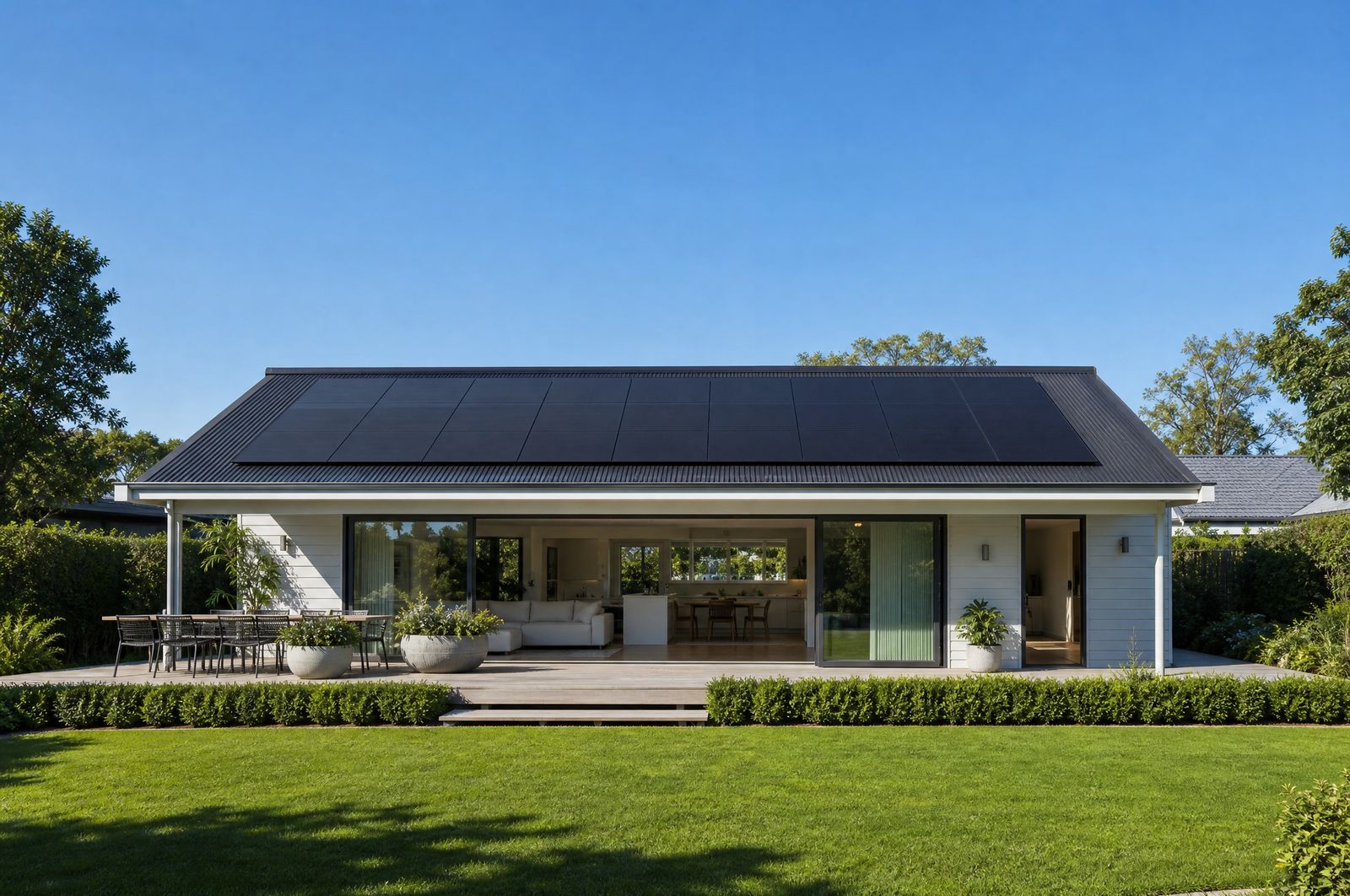
A standard residential panel wires 60–72 of these cells together in a sealed, weatherproof unit. Individually a cell produces only a small amount of power; wiring dozens together, and multiple panels together into an array, is what scales the output up to something that can run a house.
From DC to AC: the inverter's job
An inverter is the device that converts a solar panel's DC output into the AC electricity your home actually runs on. The DC electricity a panel produces isn't directly usable by most NZ homes — appliances, lighting, and the electricity grid all run on alternating current (AC). That conversion is the job of the inverter, a piece of equipment installed alongside the panels (usually in a garage, on an external wall, or near the switchboard).
- String inverter — one central inverter converts the combined DC output of all panels at once; the most common and cost-effective setup for a typical NZ roof.
- Microinverters — a small inverter fitted to each individual panel, converting DC to AC at the panel itself; costs more but means shading or a fault on one panel doesn't drag down the whole array's output.
- Hybrid inverter — manages solar, a battery, and the grid together; the standard choice when a battery is part of the system, whether installed now or planned for later.
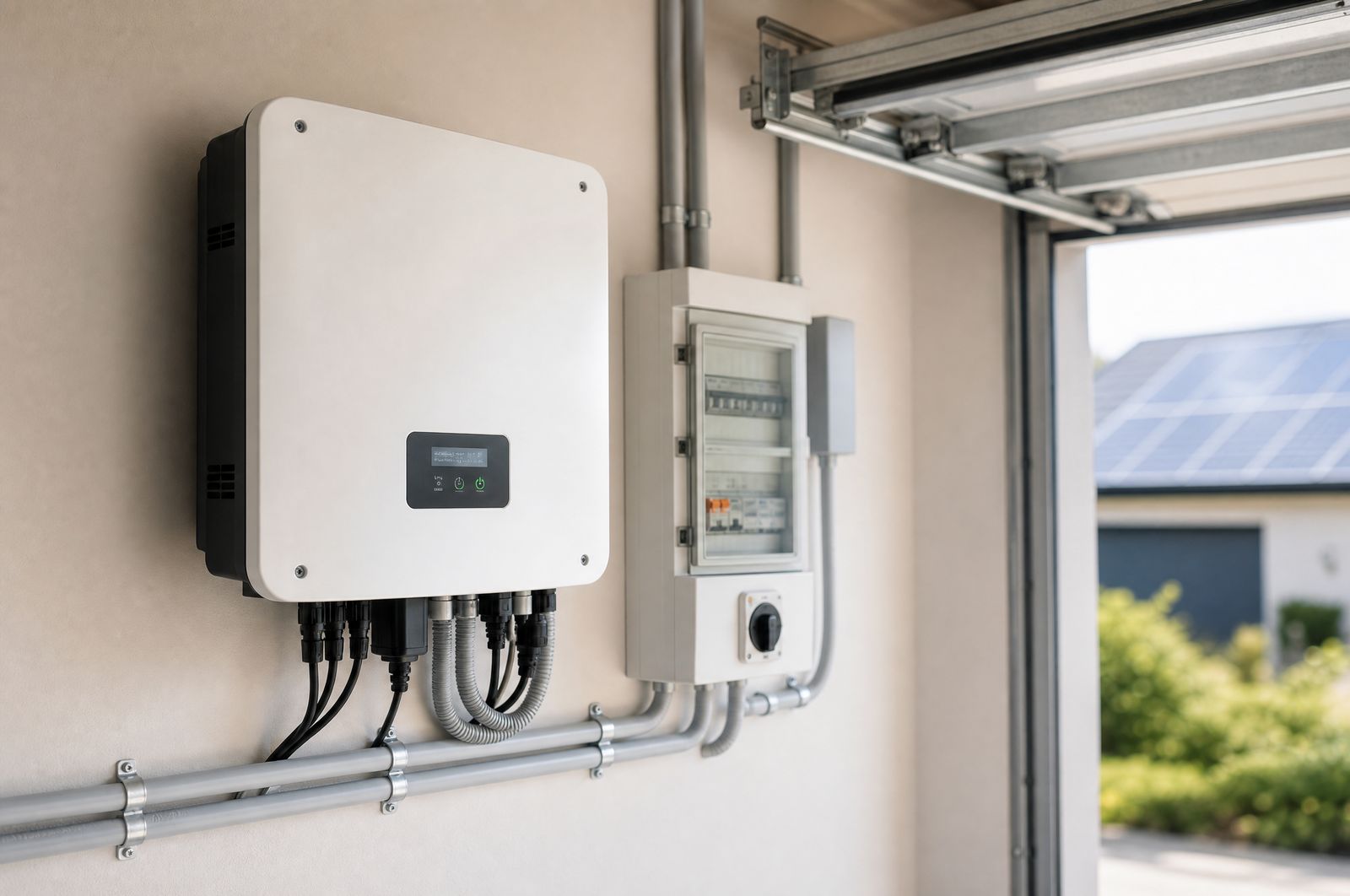
Once converted to AC, the electricity feeds into your switchboard exactly like grid power does. Your home draws on solar power first, automatically, before pulling anything from the grid — no manual switching is involved. From September 2026, installing this equipment as part of a grid-connected system in NZ requires a specific EWRB accreditation, not just a standard electrician's licence — see our installation rules guide for what that covers. Inverters are generally warrantied for 5–10 years and typically last 10–15 years in service, roughly half the working life of the panels themselves, so most systems need one inverter replacement over the panels' lifetime.
Panel types and efficiency
Panel efficiency is the share of sunlight a panel converts into electricity. Most panels sold in New Zealand today convert roughly 15–22% of the sunlight that reaches them, depending on the panel type. Almost all of those residential panels are one of two silicon types, both using the same photovoltaic effect described above — the difference is how the silicon is manufactured, which affects efficiency, appearance, and price:
| Panel type | Typical efficiency | Typical cost | Best for |
|---|---|---|---|
| Monocrystalline | ~19–22% | Higher | Small or shaded roofs where output per panel matters most |
| Polycrystalline | ~15–17% | Lower | Larger roofs with space to spare, budget-focused installs |
| Thin-film | ~10–13% | Lowest per watt, more panels needed | Large commercial or flexible-mounting applications, rarely used residentially |
Typical efficiency and relative cost ranges for panels sold in New Zealand in 2026 — actual figures vary by brand and model; check the datasheet for any specific panel.
"Efficiency" here means the share of the sunlight hitting the panel that gets converted into electricity — a 20%-efficient panel of a given size produces more power than a 16%-efficient panel the same size, but takes the same physical space either way. Most panels installed on NZ homes today are monocrystalline, since the higher efficiency generally makes better use of a limited roof area. See our solar panel cost per watt guide for how panel choice affects total system price.
What affects how much power your panels produce
Five factors determine how much power a solar panel actually produces: orientation, tilt angle, shading, temperature, and cleanliness. Two identical panels can produce noticeably different amounts of power depending on where and how they're installed:
- Orientation — in New Zealand (Southern Hemisphere), a north-facing roof gets the most consistent sun through the day and typically produces the most; east- and west-facing panels still work well, generating more in the morning or afternoon respectively.
- Tilt angle — roughly matching your latitude generally maximises annual output; most existing roof pitches are close enough that a special tilt frame isn't needed.
- Shading — even partial shade on one panel (a tree, a chimney, a neighbouring roofline) can disproportionately cut output from an entire string, which is why a proper site assessment checks shading patterns across the day and year.
- Temperature — panels lose a small amount of efficiency as they heat up, which is why panel performance is usually rated at a standard 25°C and real-world output on a very hot day can be slightly lower than the nameplate figure, even with strong sun.
- Dirt and dust — a light film of dust or pollen has a minor effect; heavier buildup or bird droppings can meaningfully reduce output on the affected cells until cleaned. See our solar panel maintenance guide for cleaning and upkeep specifics.
None of these factors change how a panel works — only how close it gets to its rated output on a given day. A proper installer accounts for all of them when sizing and positioning a system, which is why a desktop estimate is always rougher than an on-site assessment — see our how many solar panels do I need guide for how that sizing works in practice.
The full system: panels, inverter, meter, and battery
A working solar installation is more than panels on a roof. The complete picture:
- Panels generate DC electricity from sunlight, as covered above.
- Inverter converts that DC into usable AC and feeds it into your switchboard.
- Meter — most homes need a smart meter, upgraded or reconfigured, to measure power flowing both ways: what you draw from the grid and what you export back to it.
- The grid connection — sign-off from your local lines company (the regional network operator that owns the lines running to your property) confirming the network can accept power flowing back from your system, which is what lets any solar power your home doesn't use in real time flow outward instead of going to waste. The Electricity Authority sets the overall rules distributors work within for connecting small-scale generation like rooftop solar — see our installation rules guide for how that approval process works in practice.
- A battery, if fitted, stores solar power generated during the day instead of exporting it, so it's available to run the house after dark — reducing how much grid power you buy in the evening.
Unlike Australia's federal Small-scale Renewable Energy Scheme (STC rebate), New Zealand has no national government rebate for solar — there's no upfront subsidy built into the price. The economics instead rest on two things: what you stop paying your retailer for imported power once panels are producing, and what your retailer credits you for any surplus power you export, since buy-back rates are set individually by each retailer rather than fixed nationally. Installation must be carried out by an EWRB-accredited electrician and signed off by your lines company before it can legally connect and export — see our installation rules guide for the full compliance picture and our solar installation process guide for how these steps fit into an install timeline. If you're weighing up whether it's worth doing at all, our is solar worth it guide walks through the numbers, and our 6kW system cost guide covers typical pricing for a common NZ household size.
Common questions
How do solar panels work in simple terms?
Sunlight hitting the silicon cells inside a panel knocks electrons loose, creating a flow of DC electricity — this is the photovoltaic effect. An inverter then converts that DC power into the AC electricity your home's appliances and lighting actually use.
Do solar panels still work on cloudy days in NZ?
Yes, but at reduced output. Panels generate electricity from daylight, not direct sunshine alone, so they keep producing on overcast days — typically well below their clear-sky output, since less light energy is reaching the cells.
What's the difference between monocrystalline and polycrystalline panels?
Monocrystalline panels are typically more efficient (around 19–22%) and cost more; polycrystalline panels are less efficient (around 15–17%) and cheaper. Most NZ homes now use monocrystalline panels, since higher efficiency makes better use of limited roof space.
Why do I need an inverter with solar panels?
Panels produce DC electricity, but NZ homes and the grid run on AC. The inverter converts DC to AC so the power can run your appliances or export to the grid. Without an inverter, the electricity your panels generate can't actually be used.
Is there a government rebate for solar panels in NZ?
No. Unlike Australia's federal STC scheme, New Zealand has no national solar rebate. Savings instead come from avoiding retail import prices once your panels are producing, plus whatever buy-back rate your retailer credits for exported power.