What Type of Solar Panel Is Best for Your NZ Home?
Most New Zealand homes today are fitted with monocrystalline panels, the highest-efficiency mainstream option — polycrystalline and thin-film exist but are rarely used on residential rooftops anymore. The three underlying panel technologies are monocrystalline, polycrystalline, and thin-film, and the choice mostly comes down to how much usable roof space you have versus how much you want to spend, since efficiency and price move together.
Quick answer: for a typical NZ roof, monocrystalline (specifically mono PERC) is the standard choice in 2026 — it fits more output into less space, which matters more than the modest price gap over polycrystalline once you compare full-system quotes. Panel technology is only one input into total cost — see our 6kW solar system cost guide for what a full system runs.
The main types of solar panels
There are three main types of solar panels: monocrystalline, polycrystalline, and thin-film — categories defined by how the silicon or other photovoltaic material inside the cell is structured. Almost every panel sold for NZ residential installs falls into one of these three underlying technologies. That structural difference drives everything else — efficiency, appearance, cost, and how much roof space you need for a given system size:
- Monocrystalline — cut from a single, pure silicon crystal. Highest efficiency, uniform black appearance, the default choice for most new NZ installs.
- Polycrystalline — made from multiple silicon fragments melted together. Slightly lower efficiency, a distinctive blue speckled look, historically cheaper but now a shrinking share of the market as mono prices have fallen.
- Thin-film — a thin layer of photovoltaic material (amorphous silicon, CdTe, or CIGS) deposited on a backing. Lightweight and flexible but meaningfully less efficient — mostly used in commercial, off-grid, or specialised applications rather than standard rooftops.
Within monocrystalline, most panels sold in NZ today are also PERC (Passivated Emitter and Rear Cell) panels, often combined with half-cut cells and sometimes a bifacial (double-sided) design — these are refinements of mono technology, not a separate category, and they're the reason a 2026 panel outperforms an equivalent-looking panel from a decade ago.
Monocrystalline panels
Monocrystalline panels are cut from a single silicon ingot, which gives the cells a uniform structure and, in turn, the highest efficiency of the three mainstream types — typically in the high-teens to low-20s percent range for panels currently sold in NZ, depending on the specific model and cell technology. That higher efficiency means fewer panels are needed to reach a given system size (covered against household usage in our how many solar panels guide), which matters most on roofs with limited usable area — a common constraint on NZ sections with steep pitches, dormers, or shading from neighbouring trees.
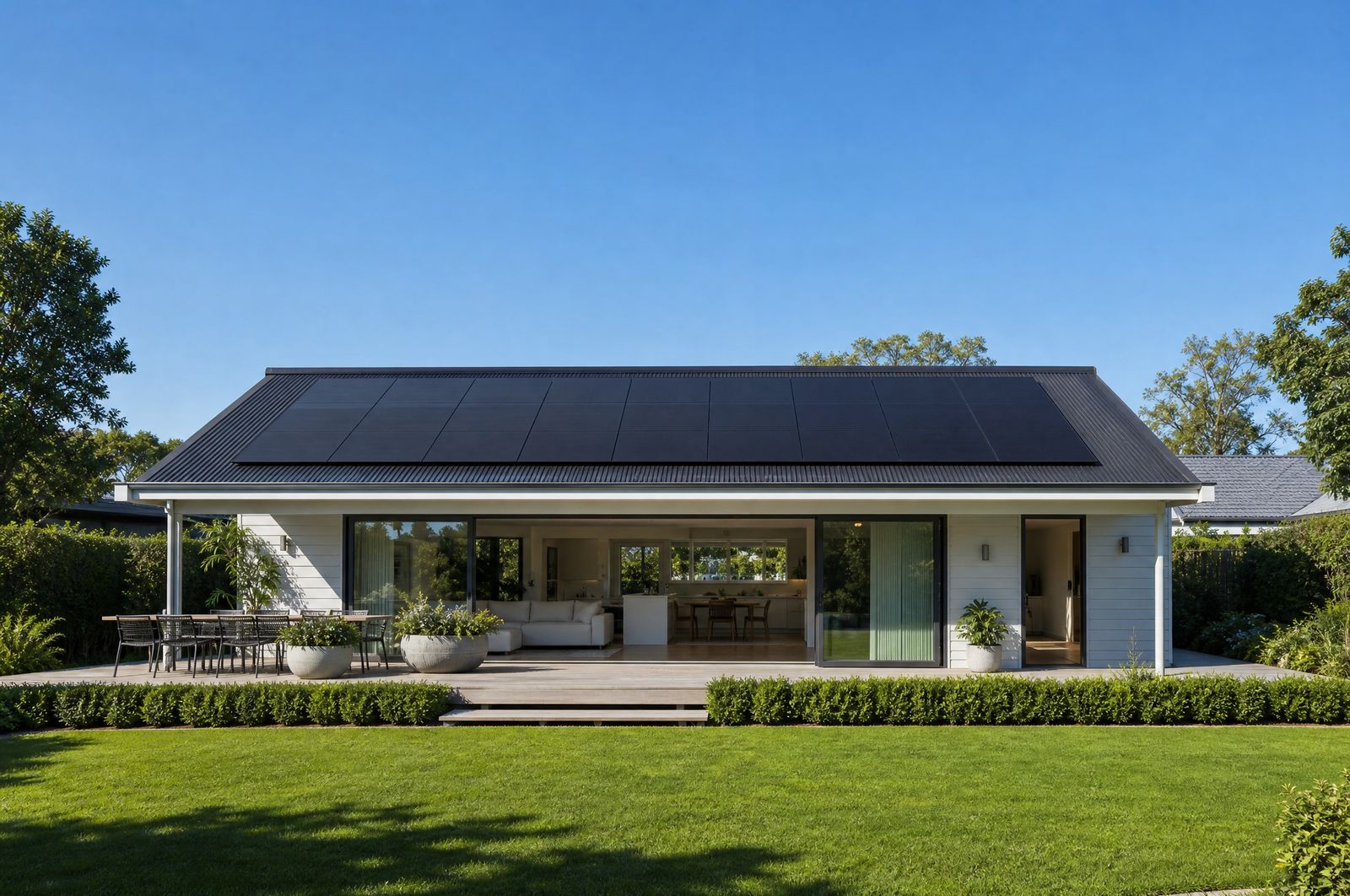
The trade-off is a modest price premium per panel over polycrystalline, though that gap has narrowed considerably over the past decade as mono manufacturing has scaled up — for most quotes today, the total system price difference is smaller than the efficiency difference would suggest. Monocrystalline also tends to perform marginally better in low light than polycrystalline, which is relevant across NZ's more overcast regions.
Polycrystalline panels
Polycrystalline panels are made by melting multiple fragments of silicon together into a single cell, rather than using one continuous crystal. That process is cheaper and produces less waste silicon, which historically made polycrystalline the budget option — but it also results in a less uniform crystal structure, so electrons have a slightly harder path through the cell and efficiency comes in lower, typically in the mid-teens percent range.
Polycrystalline panels are identifiable by their blue, speckled appearance rather than mono's uniform black. In NZ, polycrystalline has become a shrinking share of new residential installs: as monocrystalline manufacturing costs have fallen, the price gap that used to justify choosing polycrystalline has narrowed, while the efficiency gap hasn't — meaning polycrystalline no longer wins on value the way it once did for most standard rooftops. It can still make sense where you have generous roof space and efficiency-per-panel matters less than minimising upfront panel cost, but get a like-for-like comparison from your installer before assuming it's the cheaper path once labour, mounting, and inverter costs are included — see our cost per watt guide for comparing quotes on that basis.
Thin-film panels
Thin-film panels use a much thinner layer of photovoltaic material — amorphous silicon, cadmium telluride (CdTe), or copper indium gallium selenide (CIGS) — deposited onto a backing rather than built from silicon wafers. That makes them lighter, flexible in some formats, and generally cheaper to manufacture per square metre, but efficiency drops well below mono or poly, typically into the low-teens percent or lower.
For a standard NZ rooftop, thin-film rarely makes sense: you'd need a much larger area to reach the same output as mono or poly panels, and most residential roofs don't have the spare space to absorb that trade-off. Thin-film sees more use in large-scale commercial or utility installations where land or roof area is abundant, in specialised off-grid or portable applications (such as motorhomes and boats), or on structures that can't support the weight of standard rigid panels. If an installer proposes thin-film for a typical home, it's worth asking directly why — it's the exception on residential NZ roofs, not the rule.
Efficiency and output compared
Efficiency measures how much of the sunlight hitting a panel gets converted into usable electricity — a higher number means more output from the same panel area. The ranges below reflect what's typically available in the NZ market in 2026; always check the datasheet for the specific panel on your quote rather than assuming the top of a range.
| Panel type | Typical efficiency | Typical residential use in NZ |
|---|---|---|
| Monocrystalline (incl. PERC) | ~19–22%+ | Standard choice for most new installs |
| Polycrystalline | ~15–17% | Declining share; budget-focused, larger roofs |
| Thin-film | ~10–13% | Rare on rooftops; commercial/off-grid niches |
Efficiency isn't the only factor in real-world output — orientation, shading, tilt, and local weather all matter too, and are covered in more general terms in our how solar panels work guide.
Efficiency also interacts with degradation over time: most panels sold today, across all three types, carry a performance warranty guaranteeing a large majority of original output after 25 or so years, though the exact figures vary by brand and are worth confirming directly with your installer — see our solar panel maintenance guide for how warranty terms and panel lifespan typically break down.
What "Tier 1" actually means
"Tier 1" is a financial bankability ranking compiled by Bloomberg New Energy Finance (BNEF), not a technical quality or performance rating — a common misconception worth clearing up before you use it to compare quotes. The classification reflects whether a manufacturer has self-financed at least a handful of utility-scale solar projects using its own panels, on the logic that a bank willing to finance a large project on a manufacturer's panels is a reasonable proxy for that manufacturer's financial stability. It says relatively little about the specific efficiency, warranty terms, or build quality of an individual panel model.
That doesn't make Tier 1 status meaningless — an established, financially stable manufacturer is generally a safer bet for honouring a 25-year warranty than an unknown brand. But unlike Australia, NZ doesn't run a government-maintained approved-products list for solar panels — so the practical checks for a Kiwi homeowner sit elsewhere: Tier 1 status as one signal of manufacturer stability, a written performance and product warranty from the panel brand, and confirming your installer holds current EWRB accreditation for solar work, the same accreditation check covered in our installation rules guide. SEANZ membership is a further signal an installer is committed to industry standards, on top of EWRB accreditation itself.
Which panel type suits your home
For the large majority of NZ homes, the practical decision in 2026 is less "which of the three technologies" and more "which monocrystalline brand and model" — polycrystalline and thin-film have become niche choices rather than mainstream alternatives. A few situations where the type genuinely matters:

- Limited roof space or partial shading — favour monocrystalline (and consider half-cut or bifacial variants) to maximise output per panel.
- Large, unshaded roof, tight budget — polycrystalline can still be a reasonable value trade-off, but compare full installed-system quotes, not just panel unit price.
- Non-standard structure (curved, lightweight, portable) — thin-film may be the only physically viable option, but this is uncommon for a standard house.
- Long-term ownership plans — since panels are expected to run for 25-plus years, warranty terms and manufacturer stability (see Tier 1 above) matter as much as the raw technology choice.
Whichever type you're quoted, get the panel brand, model, and efficiency figure in writing and confirm your installer's EWRB accreditation before signing — see our 6kW system cost guide for how panel choice fits into the total quoted price.
Common questions
What is the most common type of solar panel in NZ?
Monocrystalline, usually as mono PERC, is the standard choice for most new residential installs in NZ in 2026. It offers the highest efficiency of the mainstream panel types, which suits typical suburban roof sizes.
What's the difference between monocrystalline and polycrystalline solar panels?
Monocrystalline panels are cut from a single silicon crystal, giving higher efficiency (typically ~19-22%+) and a uniform black look. Polycrystalline panels are made from melted silicon fragments, giving lower efficiency (typically ~15-17%) and a blue speckled look, historically at a lower price.
Are monocrystalline panels worth the extra cost over polycrystalline?
For most homes, yes — the price gap has narrowed as mono manufacturing has scaled, while the efficiency advantage hasn't, so monocrystalline now often wins on full-system value, not just performance.
Does 'Tier 1' mean a solar panel is higher quality?
Not directly. Tier 1 is a Bloomberg NEF bankability ranking based on manufacturer financing history, not a technical quality score. NZ has no government approved-products list like Australia's — pair Tier 1 status with a written warranty and a check that your installer holds EWRB accreditation.
Are thin-film solar panels used on NZ homes?
Rarely. Thin-film's lower efficiency means a much larger area is needed for the same output, so it's mostly used in commercial, off-grid, or specialised applications rather than standard residential rooftops.
How much roof space do I need for monocrystalline panels?
It depends on your system size and the specific panel's efficiency — higher-efficiency monocrystalline panels need less area per kW than polycrystalline. Our system cost and sizing guides break this down by system size.